How to get shade under a pergola
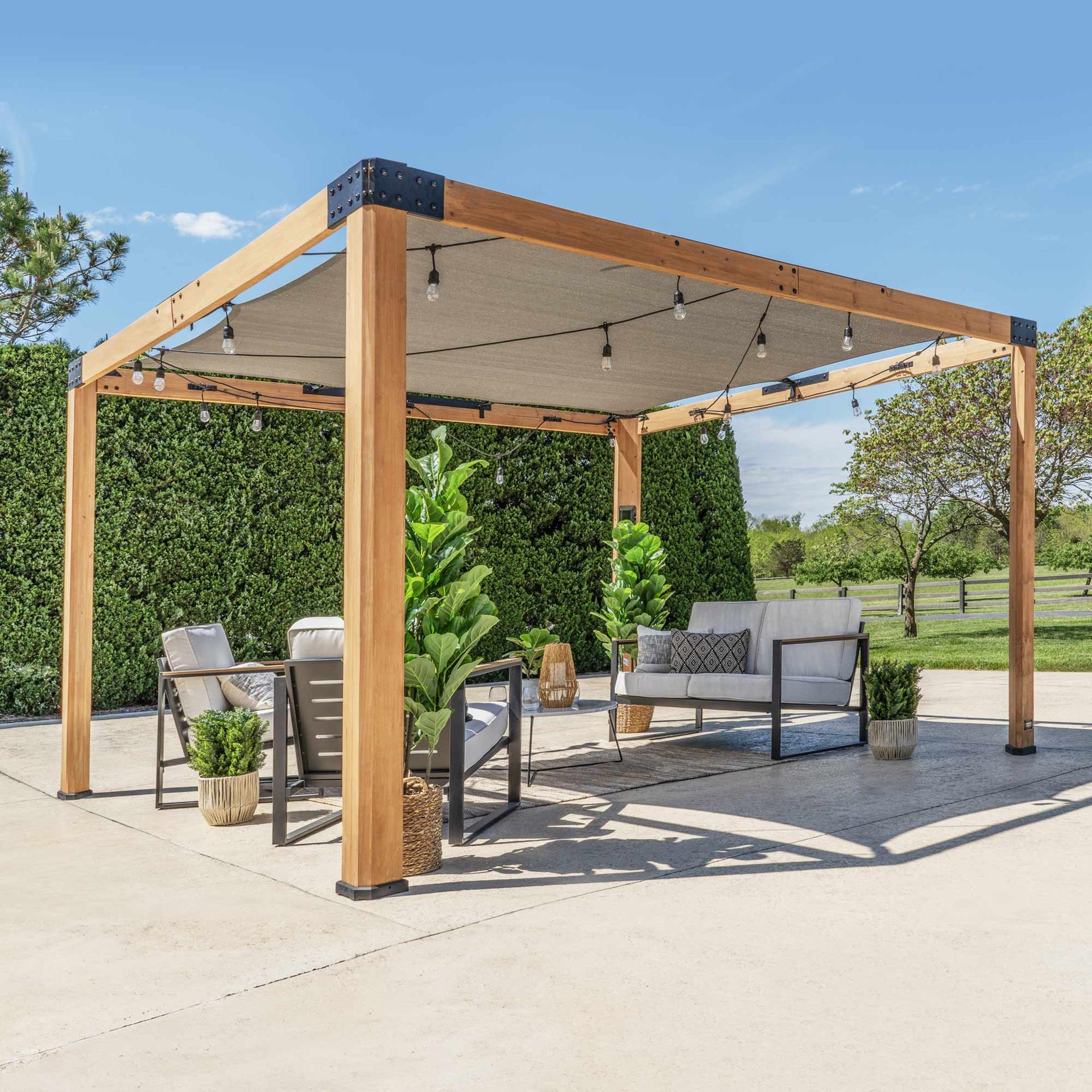
A pergola gives only as much shade as its roof, so the cheapest fix is cloth stretched across the top, and the most flexible is a louvered roof or sliding canopy you can open and close. Curtains and screens do a different job: they block the low morning and evening sun and give privacy, not the sun overhead. If you’re still buying, pick a kit with the shade built in.
Every one of these options can fail in the same two ways, wind and water, and the fix is cheap if you plan for it before you buy.
Updated Oct 20, 2026 · How we chose
Which situation are you in?
- I’m buying a pergola and want shade from day one
- Choose a roof that moves or a fixed roof
- I own an open pergola and want cheap shade this summer
- Shade cloth or a sail
- The sun hits from the side, or I want privacy
- Curtains or pull-down screens
- I’m worried about storms
- Plan for wind and rain first
Six ways to shade a pergola, and what each costs
The cheap options go over or around the frame you already have. The dearer ones replace the roof, so you’re really buying a different pergola. Costs for cloth and curtains are retailer listings read on 20 October 2026, and kit costs are from our Pergola Price Index.
| Option | What it shades | Cost | The catch |
|---|---|---|---|
| Shade cloth or a sail | The sun overhead | About $20 to $250 for a patio-size piece | Lets some rain through, flaps in wind and fades |
| Outdoor curtains | Low sun from the side, and privacy | About $50 for a ready-made pair, custom sizes from about $80 a panel | Wind blows them about, and they don’t shade the roof |
| Sliding fabric canopy kit | The sun overhead, and you can open it | About $410 for a 10×12 kit | No gutter, so rain runs off the edge, and the fabric wears out first |
| Louvered roof | The sun overhead, adjustable, and closes against rain | About $1,800 for a manual 10×12 kit | A motor costs far more |
| Pull-down screens | Side sun and privacy, built into some louvered kits | Kits that include them start around $2,600 | Few kits have them, and they’re sold with the whole pergola |
| Fixed hardtop roof | All-day shade and rain cover | About $930 to $1,500 for a 10×12 hardtop gazebo | Never opens, and most are sold as gazebos |
Cloth, sail and curtain costs from Home Depot, Wayfair, Lowe’s and maker listings, 20 October 2026. Kit costs are typical 10×12 prices from the Pergola Price Index (captured 24 to 27 September 2026); the hardtop row is a range for hardtop gazebos, which the index prices separately. Pull-down screen kits from our catalogue, read 20 October 2026.
If you’re buying a pergola for shade, choose the roof first
Shade you add later is a patch on a frame built for something else. If shade is the reason you’re buying, pick the roof first and let the frame follow.
A sliding fabric canopy is the cheapest roof you can open. Pull it across on a hot afternoon and slide it back in the evening. Its limit is rain: none of these kits has a gutter, so water runs off the edge. We cover the kits, and what to check on the warranty and the replacement canopy, on retractable pergolas.
A louvered roof gives shade and closes against rain, which is why it costs more. The slats tilt, so you choose how much sun gets through, and when they’re shut the roof sheds water. Louvered pergolas shows every kit at your size, and manual or motorized shows what a motor really adds.
A fixed roof shades all day and never moves. Most are steel or polycarbonate, and most are sold as hardtop gazebos rather than pergolas. Pergolas with a roof explains both kinds. A roofed structure can also be treated differently from an open pergola when a city decides whether you need a permit, so check yours before you buy.
Kits that come with the shade
A few kits ship with curtains, netting, screens or a sail, so you’re not hunting for a size that fits afterwards. These four are the clearest examples:
| Product | Size | Roof | Price |
|---|---|---|---|
| EROMMY Louvered Pergola with Adjustable Rainproof Rooflouvered, side curtains and mesh netting included, one-year warranty | 10×10 ft | Manual louvers | $999.99 |
| Domi Outdoor Living Aluminum Louvered Pergolalouvered, curtains and netting included except in the white listing | 10×10 ft | Operation not published | $1,599.99 |
| Backyard Discovery Brendan Sail Shade Pergolacedar, shade sail included | 12×10 ft | Canopy | $699 |
| EROMMY Louvered Pergola with Pull-Down Screenslouvered, four pull-down side screens | 10×12 ft | Manual louvers | $3,699.99Last observed price |
Brand list prices, before tax, delivery and installation. Brands often run promotions, so check the live price before you order. Kit contents from Erommy’s curtains-and-netting listing, Domi’s louvered pergola page, Backyard Discovery’s Brendan page and Erommy’s pull-down screens listing, read 2026-10-20.
Included curtains are the weakest part of the package. Domi covers the roof and frame for five years but the curtains and netting for one, so plan on replacing the fabric first.
Shade cloth and sails for a pergola you already have
For an open pergola this is the cheapest overhead shade. The cloth listed for pergolas at Home Depot and Lowe’s is mostly labeled 90 percent. That label is a shade factor, not a measure of ultraviolet light. One cloth maker’s data sheet warns that the shade factor “is not a specific measurement of Ultra Violet Radiation,” and it gives about 69 percent for green cloth against about 94 percent for black. Color changes the shade you get, so read the label for the color you’re buying.
You need a ladder, a drill or staple gun, and someone to hold the far end. A cloth seller’s install guide says to leave 8 to 12 inches of overhang on every side, fix the edge nearest the house first, then fasten every 12 to 18 inches across the beams, closer if your site is windy. It recommends stainless steel hardware.
A sail is the same idea with a different fixing. Instead of lying flat on the beams, it is pulled to the corners with straps. Some kits include one, like the Brendan above.
What the cheap cloth can’t do
Cloth sold as shade lets some rain through, so it protects your skin and not your furniture. One seller’s knit shade cloth is described as giving only light rain protection because it isn’t waterproof. If you want rain cover too, go to the waterproof kind, and read the next section before you do.
Curtains and screens: the side sun and privacy
Curtains do something a roof can’t. When the sun drops, it comes in sideways under the beams, and only a vertical panel stops it. They also give you privacy from the neighbors.
They don’t shade the top of the pergola, so people who want both put cloth or a canopy overhead and curtains around the sides.
A few choices decide whether they last. Pick fabric made for outdoors: a decor publisher’s curtain guide says polyester blends are cheap but fade and need replacing about every two years, cotton mildews, and indoor curtains aren’t suitable at all.
Check the length against your pergola. Many ready-made panels are 84 inches long, and Costco lists the Mirador louvered pergola at about 8 ft 3 in tall, so an 84-inch panel hangs about 15 inches short of the floor. Measure from the rail to the ground before you order, or choose a custom size.
A rod with brackets is the easiest way to hang them, and the same guide advises a center bracket on wide spans so the rod doesn’t bow. Tension rods and wire suit light curtains and narrow openings only.
If you want screens that retract rather than curtains, look at kits that include them. Erommy’s pull-down screens kit has four that retract into the housing, and louvered pergolas lists the rest of the louvered kits.
Wind and rain: the two things that break shade
Fabric on a pergola catches the wind like a sail. It pulls on every fixing, and the loose edge of a curtain or cloth flaps until something gives. Makers know it. Domi’s own pergola page tells owners to tie the curtains up in storms. A sail maker says to take a sail down when a storm is predicted, not once it arrives, and to check the hardware afterwards.
So plan to take shade down or tie it back when a storm is forecast, and fix it well enough to survive a gusty day you didn’t plan for. Fasten more often rather than less, and use hardware that won’t rust out of a beam.
Rain is the other trap. Waterproof fabric stretched flat sags into a bowl, the water pools in the middle, and every pound of it pulls on the fixings. A shade-sail specialist quoted in a trade magazine advises against waterproof sails unless the design leaves enough slope for the water to run off. If you want a waterproof cover on a flat pergola, fix it at a slope, with one end lower than the other, or accept that it will pool.
A cloth seller adds a related point about wide panels: its Sunbrella panels 36 inches wide or more need drainage grommets about 18 to 24 inches apart so the water has somewhere to go.
What owners say about curtains, cloth and canopies
Owner reviews of curtains, shade covers and replacement canopies complain about the same three things, and none of them is the fabric’s shade.
The first is size. Buyers report panels and canopies that came up shorter than the listing, in some cases by well over a foot, so measure the finished piece rather than the fabric size on the product page. The second is what’s missing from the box: a few buyers received curtains with no ties or hooks to hang them, and the panels blew around loose. The third is how long the fabric lasts. Reviewers describe sheer polyester curtains fading within six months, clear vinyl tearing before a year, and canopies lasting from a year or so to about three.
Water and wind come up too. Owners of waterproof covers describe rain collecting between the slats or pooling on the fabric, and one owner of a canopy kit reports the whole top collapsing in a rain-and-wind storm. What they praise is heavy, thick fabric, grommets all the way round, and clear panels that keep the view while blocking wind and rain.
Sources (10)
- Shade-cloth seller, how to cover a pergola (install guide) · retrieved Oct 20, 2026
- Shade-cloth seller, retractable pergola shade (wire systems, Sunbrella drainage) · retrieved Oct 20, 2026
- Homedit, curtains for a pergola · retrieved Oct 20, 2026
- Fabric Architecture, shade sail dos and don’ts · retrieved Oct 20, 2026
- Shade Sails Canada, should I take my shade sail down in a storm · retrieved Oct 20, 2026
- Shade cloth manufacturer data sheet (shade factor and UV) · retrieved Oct 20, 2026
- Domi Outdoor Living, aluminum louvered pergola · retrieved Oct 20, 2026
- Erommy, louvered pergola with curtains and netting · retrieved Oct 20, 2026
- Erommy, louvered pergola with pull-down screens · retrieved Oct 20, 2026
- Backyard Discovery, Brendan sail shade pergola · retrieved Oct 20, 2026
Questions
What is the cheapest way to shade a pergola?
Shade cloth. Patio-size pieces with grommets are listed at about $20 to $160 at Home Depot, Lowe’s and Wayfair, and you fix them to the beams with stainless hardware every 12 to 18 inches. See shade cloth.
Can you put shade cloth on a pergola?
Yes. Leave 8 to 12 inches of overhang on every side, fix the edge nearest the house first, then fasten across the beams every 12 to 18 inches, closer if it’s windy. Cloth lets some rain through.
Do pergola curtains work in the wind?
Not well on their own. Makers tell owners to tie curtains up in storms, and long panels catch gusts like a sail. Hang them on a sturdy rod, and tie them back or take them down when a storm is forecast.
Can you put a shade sail over a pergola?
Yes, and some kits come with one. Pull it taut to the corners, and if it’s waterproof, fix it at a slope so rain runs off instead of pooling in the middle.
How do I get a pergola with retractable shades?
Buy a kit that has them. A sliding canopy kit costs about $410 at 10×12 and opens like a roof, while a louvered kit with pull-down side screens starts around $2,600. See retractable pergolas.
Will a pergola keep the rain off?
Only with a roof that closes. Louvers that shut and fixed hardtop roofs shed rain; shade cloth and most canopy kits don’t. See louvered pergolas.