Do you need a permit for a pergola?
Usually not, if it’s small, freestanding, open-roofed and has no wiring, but small is smaller than most people think. Many cities draw the line at 120 square feet, a 10×12, not the 200 you often hear. Attach it to the house, wire in lights or a fan, or put a roofed kit in Florida’s hurricane zone, and you’ll usually need one. Your HOA is a separate yes.
A 12×16, one of the most common kit sizes, is over the line in 16 of the 24 places we checked. And the permit is rarely the hard part.
Updated Oct 13, 2026
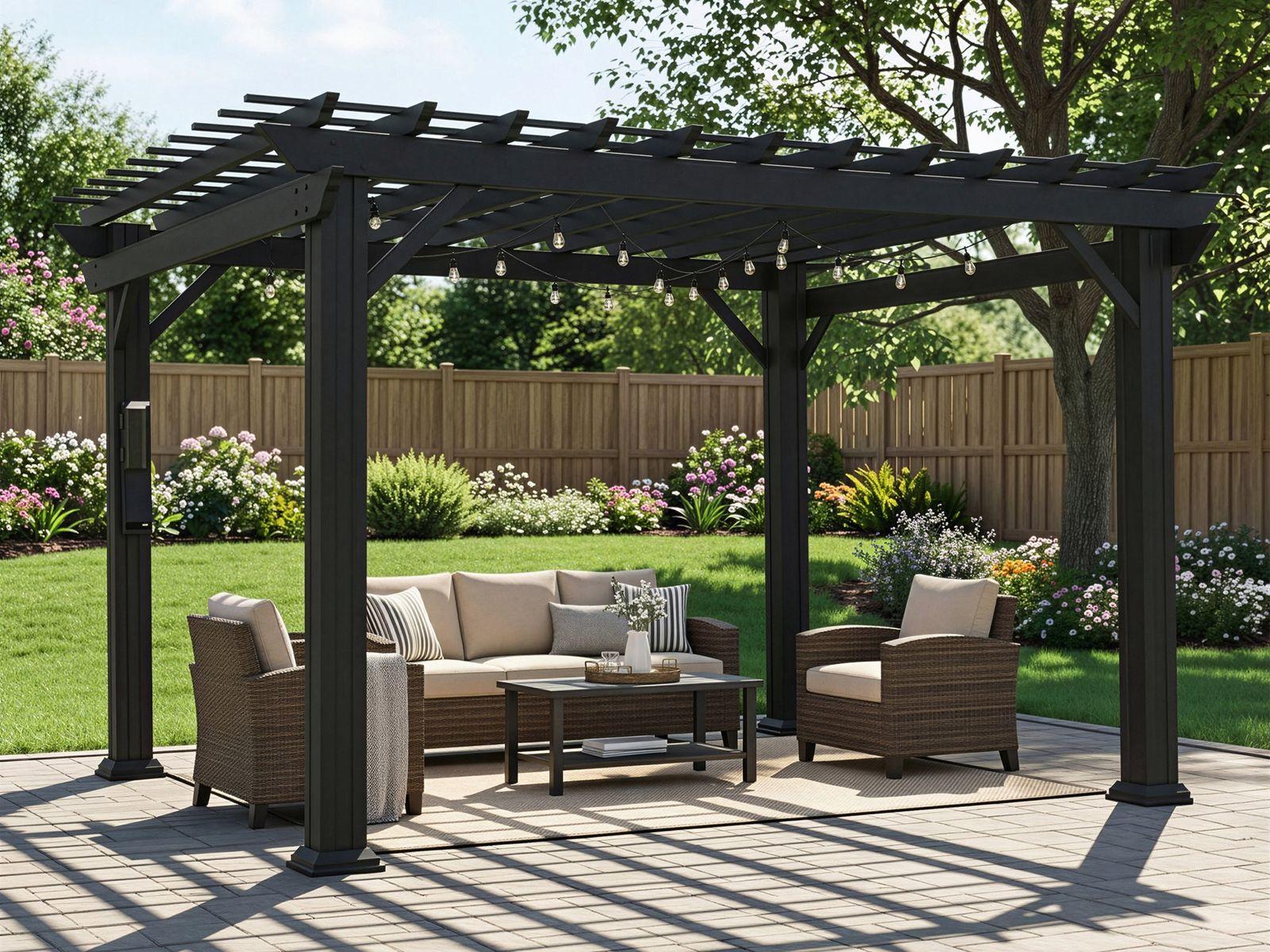
Check yours in 30 seconds
Drag the corner to your size, then tap the roof, the house or the light to match your plan. Every city and county on the ruler is one whose official rules we read, and each one turns green, amber or red for your pergola.
Permit checker
Drag the corner to size it. Tap the roof, the house or the light to change them.
No building permit likely in 7 of 24 places.
1 more wants you to ask first, 11 draw the line below 192 sq ft and 5 have no size exemption.
Zoning, setbacks and your HOA still apply, so confirm with your permit office before you build.
12 × 16 ft192 sq ftCommon kit size
Where 24 US cities and counties draw the line
No size exemption
120 sq ft
150 sq ft
200 sq ft
300 sq ft
400 sq ft
A 12×12 is 144 sq ft, under the 150 sq ft line. Browse 12×12 pergolas
Which sizes stay under the line
The 200 square feet you often read about comes from the model code most US towns start from, which exempts a one-story detached structure up to that size. But many cities and counties set their own, lower line, and 120 square feet is the most common one in the places we checked. That’s a 10×12. A 10×13 is already over it.
So if you want to skip the permit, a kit of 10×12 or smaller is the safe bet. Here’s how the common kit sizes do for a freestanding pergola with an open roof and no wiring:
| Kit size (ft) | Square feet | Likely no building permit in |
|---|---|---|
| 10×10 | 100 | 17 of 24 |
| 10×12 | 120 | 16 of 24 |
| 10×13 | 130 | 9 of 24 |
| 12×12 | 144 | 8 of 24 |
| 12×16 | 192 | 7 of 24 |
| 10×20 | 200 | 7 of 24 |
| 12×20 | 240 | 4 of 24 |
Counted from the rules table below. A louvered or solid roof, attaching to the house or hard wiring each lower the count.
How the office measures matters when you’re close to a line. Some count the footprint post to post; others count the whole roof, overhang included, as San Diego does for patio covers. A kit sold as 12×12 can have a roof a little larger than its posts, so ask which number your office uses.
Under the line still means zoning applies: setbacks from the property line, height limits and how much of the yard you can cover. Philadelphia, for example, needs no building permit up to 200 square feet but won’t allow more than 130 in a rear yard without a zoning appeal.
Browse freestanding pergolas, or go straight to 10×12 kits.
Attached, louvered or wired: what changes the answer
Attached to the house
Fix a pergola to the house and almost every place treats it as an addition, which needs a permit at any size. Of the places we checked, only Portland and San Diego exempt small attached covers. If you want to avoid a permit, choose a freestanding kit and keep a gap between it and the wall.
A louvered or solid roof
An open roof of slats is the easy case. A roof that closes, louvered or solid, starts to look like a patio cover, and several places list patio covers as needing a permit: Las Vegas, Clark County and Riverside County among them. None of the offices we checked mentions louvers by name, so tell the office exactly what the roof does and ask how it classifies it.
A roofed kit also brings the questions the office asks about wind and snow, which is where the paperwork starts. More on that below.
Lights, a fan or a motor
Hard-wired lights, a ceiling fan or a motor almost always need an electrical permit, even where the pergola itself is exempt. In San Jose, Riverside County and Orange County, Florida, wiring also cancels the small-structure exemption. A plug-in motor on an existing outdoor outlet is the simplest route; a new outlet at a post usually means an electrician and a permit.
Florida
Florida’s new law lets owners skip a permit for work under $7,500 from 1 July 2026, but it excludes structural and electrical work and flood-hazard areas, so it doesn’t cover a pergola. In Miami-Dade, only an open pergola that isn’t roofed or wind-resistant skips the building permit; a roofed or louvered kit needs one, and in the hurricane zone the product needs a Miami-Dade approval (a Notice of Acceptance, or NOA). Check that the kit has one before you buy.
On a deck
A pergola on a deck is judged with the deck, and some cities, Naperville among them, put it under the deck permit. The posts must be fixed to the deck’s framing or footings, not the boards. Pergola over a deck covers the deck check.
The paperwork is the hard part
Getting a permit is usually cheap. Orange County, Florida, charges $12 for its small-pergola zoning permit, and Tampa lists a residential pergola permit at $177. What stops people is what the office asks for with the application.
Owners who needed a permit report the same requests again and again: engineering or stamped drawings, a wind rating, and footing specs for the posts. Tampa, for one, wants accessory-structure plans signed and sealed by a Florida architect or engineer. Many kit makers don’t supply those documents. One Florida owner was turned down because the kit wasn’t rated for the county’s 134 mph wind speed, and another returned a kit after the sealed-plan process went nowhere. Palm Beach County even warns buyers that prefab kits still need permits.
So before you order, ask the office which documents it needs for your kit, then check the seller can provide them. Here’s what the main kit brands say on their own sites:
| Brand | What it says it provides |
|---|---|
| The Luxury Pergola | Stamped engineering drawings for $250, standard rather than site-specific; site-specific engineering is extra and priced separately. |
| Hansø | A standard design drawing set and installation manual for your application. If the office wants stamped calculations, Hansø says they must come from a licensed local engineer. |
| Backyard Discovery | Its representatives answering buyers’ questions at Home Depot say it doesn’t have stamped engineering drawings and point to the manual and footprint. |
| Yardistry | Its FAQ doesn’t cover permit documents. Ask before you order. |
| Sunjoy | Its FAQ recommends checking local codes before assembly and doesn’t mention permit documents. |
| BON Pergola | Its permit article covers when a permit is needed and doesn’t mention permit documents. |
| PergoLux, Mirador, Purple Leaf, Erommy, Paragon | No permit documents on their sites. Ask the seller in writing before you order. |
From each brand’s own pages, read 13–14 Oct 2026. If a brand offers documents on request, get them in writing before you order.
If you need your own engineer, expect a few hundred dollars to more than a thousand: The Luxury Pergola’s standard drawings are $250, and one Florida owner was quoted $1,250 for a 240-square-foot kit. Buy where returns are easy until the office has said yes.
Do it in this order
- Check your rule. Use the checker, then call or email your building department with the size, roof, attached or not, and any wiring.
- Ask which documents it needs for a kit: drawings, calculations, a wind rating or footing details.
- Confirm the seller supplies them, in writing, for the exact model and size.
- Get your HOA’s approval in writing if you have one.
- Order, ideally where returns are easy, and keep the manual and every document.
- Book the footing inspection before you pour concrete or set the posts, if your permit has one.
- Build what was approved. A change of size, roof or position can mean a new approval.
Your HOA is a separate approval
The city and your HOA decide separately, and one yes doesn’t carry over. Owners report city permits held up by HOA rules, and HOA approvals given for a pergola the city still needed to permit.
HOAs usually ask about materials and color, height, roof type and post size, and some ask for a wind rating. That can rule out a kit the city would pass: one HOA allowed only 6×6 posts or larger. Approvals can carry conditions and have been reversed, so get yours in writing, build exactly what was approved, and keep the letter for when you sell.
Pergola permit requirements in 24 US places
Each line comes from the city’s or county’s own code or permit guide. The size is the largest freestanding, one-story structure that needs no building permit. The model code behind most local rules says exempt work must still meet the code, so “no permit” never means “no rules.”
| Place | No building permit up to | What the rule says |
|---|---|---|
| Phoenix, AZ | 200 sq ft | Detached one-story structures up to 200 sq ft need no building permit; the code names ramadas and gazebos. Attached patio covers need one, and so does wiring to an exempt structure. City of Phoenix, Work exempt from permit |
| Los Angeles (city), CA | 400 sq ft | Pergolas up to 400 sq ft are outside the building code if freestanding and outside any fire district. Attached pergolas need a permit. Los Angeles Municipal Code 91.101.5 |
| Los Angeles County, CA | 120 sq ft | Detached shade structures up to 120 sq ft and 12 ft high need no permit. Attached patio covers need one. LA County Public Works, Work exempt from permit |
| San Diego (city), CA | 300 sq ft | Patio covers up to 300 sq ft of roof and 12 ft high, attached or detached, need no building permit in single-family zones, if they stay out of required yards. City of San Diego, Information Bulletin 206 |
| San Diego County, CA | 300 sq ft | Patio covers up to 300 sq ft of roof need no building permit. San Diego County PDS 110 |
| Riverside County, CA | 120 sq ft | Detached structures up to 120 sq ft with no utilities need no permit. Solid and lattice patio covers are on the permit-needed list. Riverside County Building and Safety, Exempt work |
| Sacramento, CA | 120 sq ft | Detached single-story structures under 120 sq ft need no permit; trellises and shade structures are named. Anything attached to the house needs one, whatever its size. City of Sacramento, Residential accessory structures handout |
| San Jose, CA | 120 sq ft | Open-air structures such as gazebos and trellises up to 120 sq ft with no electricity or plumbing need no permit. City of San Jose, Accessory buildings and structures |
| Seattle, WA | 120 sq ft | Arbors and other open-framed landscape structures up to 120 sq ft need no permit. Roofed patio covers are not on the exempt list. Seattle SDCI, Do you need a permit? |
| Portland, OR | 200 sq ft | Detached structures up to 200 sq ft and 15 ft high need no building permit, and neither do attached patio covers up to 200 sq ft. Zoning setbacks still apply. Portland Permitting and Development, Residential permits |
| Las Vegas, NV | No exemption | Patio covers, attached or detached, need a building permit. The 200 sq ft exemption is for shed-type buildings. City of Las Vegas, When do I need a permit? |
| Clark County, NV | No exemption | The county says freestanding and attached shade structures and patio covers need permits. Clark County, Building violations, single-family residential |
| Houston, TX | 120 sq ft | Detached one-story structures up to 120 sq ft need no building permit. A lot in a flood zone needs a floodplain permit, which names pergolas. Houston Public Works, Residential Permitting 101 |
| Austin, TX | 200 sq ft | Detached one-story structures up to 200 sq ft and 15 ft high, with no plumbing and outside flood zones, need no building permit. City of Austin, Work exempt from building permits |
| Plano, TX | 120 sq ft | Detached structures up to 120 sq ft need no permit, though zoning still applies. Attached patio covers are reviewed as additions to the house. City of Plano, Residential patio cover permit requirements |
| Frisco, TX | No exemption | All accessory structures need a building permit, including patio covers, arbors and gazebos. City of Frisco FAQ |
| Miami-Dade County, FL | Open pergolas only | Pergolas and trellises that are non-roofed and not wind-resistant need no building permit, but do need a zoning improvement permit. A roofed or louvered kit needs a building permit and hurricane-zone product approval. Miami-Dade County, Permit exemptions |
| Hillsborough County, FL | 150 sq ft | Sheds under 150 sq ft need no permit; pergolas aren’t named, and the county says anything not on its list most likely needs one. Hillsborough County, Work exempt from permits |
| Tampa, FL | No exemption | Only shed-type structures up to 120 sq ft are exempt. The city lists pergolas under its miscellaneous permit, with signed and sealed plans. City of Tampa, How to select a permit application type |
| Orange County, FL | 120 sq ft | A freestanding one-story pergola up to 120 sq ft with no wiring or plumbing needs only a $12 zoning permit, with no engineered plans. Anything else needs a building permit. Orange County, Accessory structures less than 120 sq ft |
| Chicago, IL | 150 sq ft | A single-story detached open gazebo or similar structure up to 150 sq ft and 15 ft tall, without plumbing, needs no building permit. New wiring does. City of Chicago, Small permanent structures |
| Naperville, IL | No exemption | The city requires a building permit for secondary structures such as gazebos, and a pergola on a deck goes under the deck permit. City of Naperville, Deck, patio and other exterior improvements |
| New York City, NY | 120 sq ft | Only sheds up to 120 sq ft that aren’t fixed to the ground are listed as exempt. Pergolas aren’t named, so ask the Department of Buildings. NYC Buildings, 1 RCNY 101-14 |
| Philadelphia, PA | 200 sq ft | Pergolas follow the shed rules: no building permit up to 200 sq ft. Zoning is tighter: over 120 sq ft needs a zoning permit, and over 130 sq ft isn’t allowed without a zoning appeal. Philadelphia L&I, Shed FAQ |
Read 13–14 Oct 2026. Rules change and offices interpret them, so confirm with yours before you build.
Built without a permit?
Enforcement usually starts with a complaint from a neighbor, not an inspector driving by. The usual outcome is a notice asking you to apply for a permit after the fact or take the structure down, and some notices are dropped once the office sees the pergola was exempt all along.
It can also come up later: when you apply for a permit for other work, or when you sell and the buyer or their HOA asks about it. If you bought a house with a pergola already on it, ask the seller for any permit or HOA approval before closing.
Sources (36)
- 2021 International Residential Code R105.2, as reproduced by Grant County, WA · retrieved Oct 13, 2026
- City of Phoenix, Work exempt from permit · retrieved Oct 13, 2026
- Los Angeles Municipal Code 91.101.5 · retrieved Oct 13, 2026
- LA County Public Works, Work exempt from permit · retrieved Oct 13, 2026
- City of San Diego, Information Bulletin 206 · retrieved Oct 13, 2026
- San Diego County PDS 110 · retrieved Oct 13, 2026
- Riverside County Building and Safety, Exempt work · retrieved Oct 13, 2026
- City of Sacramento, Residential accessory structures handout · retrieved Oct 13, 2026
- City of San Jose, Accessory buildings and structures · retrieved Oct 13, 2026
- Seattle SDCI, Do you need a permit? · retrieved Oct 13, 2026
- Portland Permitting and Development, Residential permits · retrieved Oct 13, 2026
- City of Las Vegas, When do I need a permit? · retrieved Oct 13, 2026
- Clark County, Building violations, single-family residential · retrieved Oct 13, 2026
- Houston Public Works, Residential Permitting 101 · retrieved Oct 13, 2026
- City of Austin, Work exempt from building permits · retrieved Oct 13, 2026
- City of Plano, Residential patio cover permit requirements · retrieved Oct 13, 2026
- City of Frisco FAQ · retrieved Oct 13, 2026
- Miami-Dade County, Permit exemptions · retrieved Oct 13, 2026
- Hillsborough County, Work exempt from permits · retrieved Oct 13, 2026
- City of Tampa, How to select a permit application type · retrieved Oct 13, 2026
- Orange County, Accessory structures less than 120 sq ft · retrieved Oct 13, 2026
- City of Chicago, Small permanent structures · retrieved Oct 13, 2026
- City of Naperville, Deck, patio and other exterior improvements · retrieved Oct 13, 2026
- NYC Buildings, 1 RCNY 101-14 · retrieved Oct 13, 2026
- Philadelphia L&I, Shed FAQ · retrieved Oct 13, 2026
- Florida Statutes 553.79 (2026) · retrieved Oct 13, 2026
- Miami-Dade County, Notice of Acceptance 24-0926.02 (louvered pergola) · retrieved Oct 13, 2026
- City of Tampa, miscellaneous projects permit fee schedule · retrieved Oct 13, 2026
- City of Tampa, residential new accessory structure guide · retrieved Oct 13, 2026
- Palm Beach County, permitting for owners who buy prefab kits · retrieved Oct 13, 2026
- The Luxury Pergola, installation and permitting · retrieved Oct 13, 2026
- Hansø Home, “Do I need a permit for my pergola?” · retrieved Oct 13, 2026
- Backyard Discovery answers on Home Depot product Q&A (Beaumont) · retrieved Oct 13, 2026
- Yardistry, FAQ · retrieved Oct 13, 2026
- Sunjoy, FAQ · retrieved Oct 13, 2026
- BON Pergola, “Do you need a permit to install a pergola?” · retrieved Oct 13, 2026
Questions
Do I need a permit for a 10×12 pergola?
Usually not, if it’s freestanding with an open roof and no wiring: at 120 square feet it’s at or under the line in 16 of the 24 places we checked. Attaching it, a roof that closes or hard wiring can each change that.
How big can a pergola be without a permit?
Most often 120 square feet, though some places allow 150, 200 or more, and a few exempt none at all. Use the checker or the rules table for yours.
Does a louvered pergola need a permit?
More often than an open one. A roof that closes can be treated as a patio cover, which several places permit at any size. Tell your office what the roof does and ask how it classifies it.
Do I need a permit for a pergola kit from a store?
Yes, the same rules apply as for a pergola you build yourself. Buying a kit doesn’t exempt it, and the office may ask for drawings the maker doesn’t supply, so ask first.
Do I need a permit to replace an old pergola?
Usually the same as for a new one, because you’re putting up a new structure. A like-for-like repair of a few boards is different; ask your office if you’re unsure.