Pergola vs arbor, pagoda and pavilion: which one do you need?
For shade over a patio or a seating area, you want a pergola or a gazebo, and those are what we sell. An arbor is a small garden entry, a pagoda is an Asian tiered tower whose curved roof gets copied onto small garden structures, and a pavilion is a big solid-roof shelter with open sides. For a roof that keeps rain off a table, pick a hardtop gazebo. For filtered shade, pick a pergola.
The price gap between these structures is wider than the shape gap, and most of it comes from who builds them.
Updated Oct 20, 2026 · How we chose
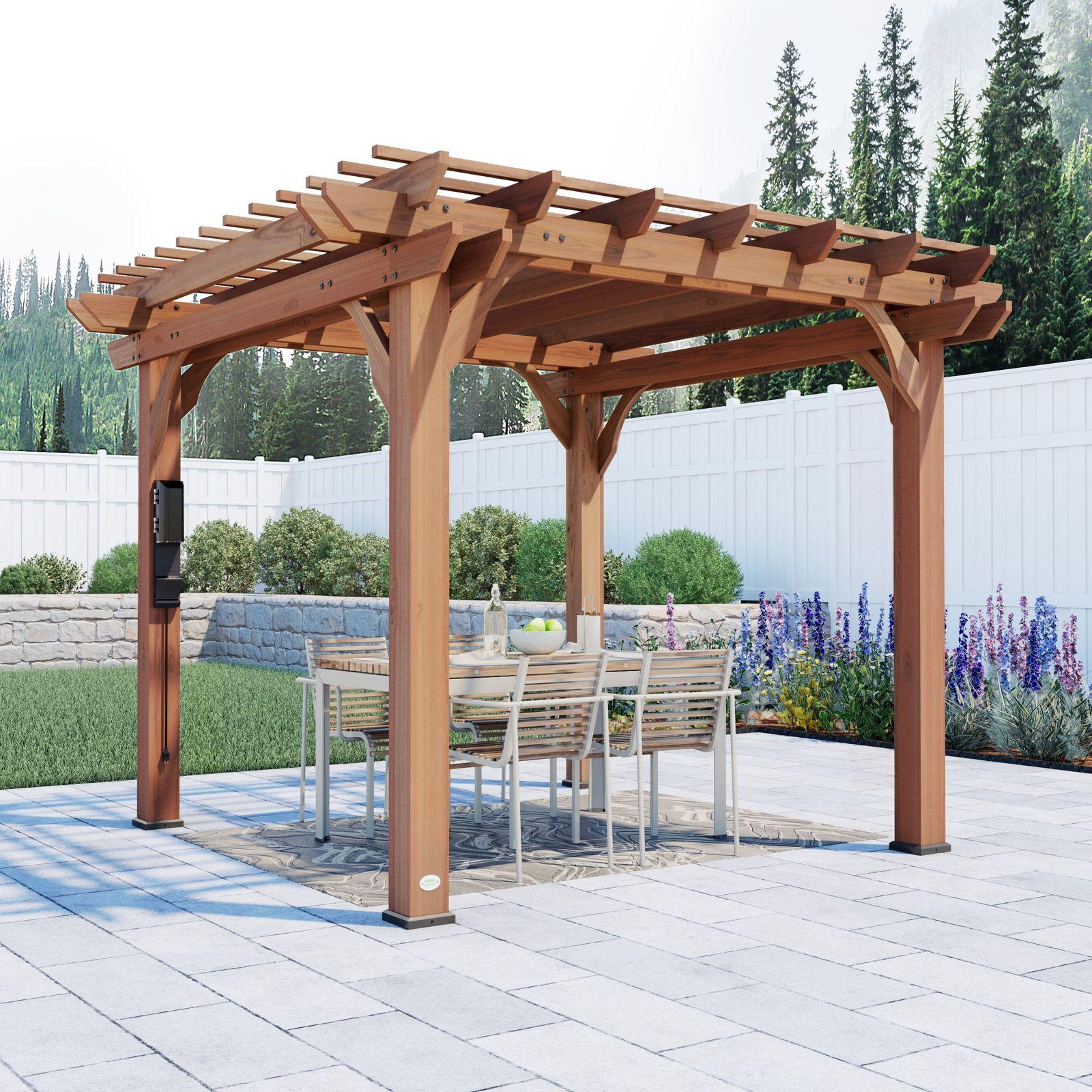
Which one do you need?
- Shade and a place to sit on a patio or deck
- A pergola
- A roof that keeps rain off a table or hot tub
- A hardtop gazebo
- An entrance to a garden or a path, with vines
- An arbor, which we do not sell
- A pagoda-style look on a patio structure
- A gazebo with a curved, tiered roof
- A big covered area for a crowd
- A pavilion, usually built to order
What an arbor is, and how it differs from a pergola
An arbor is a small garden structure, usually with two or four posts and an arched, peaked or flat top, that marks an entrance or frames a path. StruXure describes it as smaller and often simpler than a pergola, used as a garden entrance or a decorative focal point, where a pergola can cover a walkway, a seating area or a whole patio. Walpole Outdoors draws the same line: an arbor is intimate in scale, a pergola is a large open frame of posts and cross-beams.
So the practical difference is whether you sit under it. You walk through an arbor and you sit under a pergola. An arbor has no seating area, no furniture clearance and no real shade, and a pergola is sized for all three.
We sell pergolas and gazebos, not arbors. If what you want is a gate or a vine-covered entry, a garden arbor from a cedar or vinyl maker is the right product. If you want a place to sit, start with a pergola kit.
What a pagoda is, and what people mean by a garden pagoda
A pagoda is a tower from East and Southeast Asia, usually Buddhist, built in several stories, each with its own roof that curves upward at the edge. Merriam-Webster defines it that way. It is a monument you look at, not a shelter you sit in.
The pagoda sold for American backyards is something else. A timber-frame builder notes that "garden pagoda" is used loosely: it can mean a small ornamental structure, or a gazebo, pavilion or pergola with Asian-style details. Read the listing for the frame and the roof. The name tells you the look, not the structure.
Against a pergola, the difference is the roof. A pergola has open beams and rafters, or louvers. A pagoda-style structure has a solid, tiered roof, so when you are choosing what to buy, it sits with the gazebos.
Pergola vs pavilion: the roof decides it
A pavilion is a freestanding structure with a solid roof on posts and open sides. Yardistry gives its pavilions a hard A-shaped roof and a pergola a partial top. Others describe a pavilion as a large rectangular shelter that is always roofed, where a pergola gives filtered shade.
So a pavilion keeps rain off and a pergola does not, unless it is a louvered one that closes. If you want a roof you never have to think about, that is the pavilion or gazebo side of the line.
Where the line between a pavilion and a gazebo falls is a separate question, and sellers disagree. The gazebo vs pavilion guide sets their definitions side by side. How a gazebo compares with a pergola is in the gazebo vs pergola guide.
What each costs, and how much is a pagoda
There is no standard price for a pagoda, because the word is not a standard product. What you pay follows the structure under the roof. A small cedar garden pagoda arbor is about a thousand dollars; a pagoda-style roof on a gazebo costs what a gazebo costs; and a big one you can sit under is a custom build.
The numbers below mix kits and custom builds, so read them as the range, not a like-for-like list. A typical hardtop gazebo kit at 10×12 is about $1,150, a manual louvered pergola is about $1,800 and a canopy pergola is about $400, all as median kit prices in the Pergola Price Index.
| Structure | Typical price | What the price covers |
|---|---|---|
| Garden arbor or pagoda arbor | $1,218 | A cedar kit, 94 in. wide by 47 in. deep and 87 in. tall, one retailer’s sale price on 20 Oct 2026 (list $1,522) |
| Canopy pergola | $411 | Median kit at 10×12 |
| Manual louvered pergola | $1,800 | Median kit at 10×12 |
| Hardtop gazebo, including pagoda-roof styles | $1,170 | Median kit at 10×12 |
| Motorized louvered pergola | $12,999 | Median kit at 10×12 |
| Custom timber pavilion | From $10,100 | A 10×10 builder’s package with freight included; installation is priced separately |
Kit rows are Pergola Price Index medians (2026 Q4). The arbor row is one retailer’s price. The pavilion row is a custom builder’s entry tier, last updated by the builder on 5 Jun 2026.
The pavilion row is where the price gap comes from. A kit arrives in boxes for you to assemble. A custom timber pavilion is built to your site, and its price covers a much larger solid-roofed structure. The 12×12 version of the same builder’s entry tier is $12,100, so size adds less than the build does.
Louvered pergolas are the only kit that closes its roof, and they cost more for it. The cost of a motorized one is in the motorized pergola cost guide, and what installing any of these adds is in the pergola cost guide.
Do you need a permit?
It depends on the size, the roof and whether it touches your house, and the rules are local. The model building code exempts a freestanding structure up to 200 square feet, and many cities draw the line at 120. The pergola permit guide has the sizes and a checker.
A pavilion is the likeliest to need one, because it is the largest and has a solid roof. Arbors are inconsistent. Seattle’s own guidance says arbors generally need a building permit, so do not assume a small garden structure is exempt.
A pergola attached to the house or wired for lights and a motor usually changes the answer. Call your building department before you order, whichever one you choose.
What fits where
A patio or deck with a table: a pergola for shade, or a hardtop gazebo if rain matters. A 10×12 is the size most kits are sold in, and it is also the largest footprint that many towns let you build without a permit.
A path or a garden gate: an arbor, from a garden maker. It will not shade a seat.
A big lawn space for a crowd: a pavilion, usually built to order. We list no pavilions.
The look of a pagoda: a hardtop gazebo with a tiered, curved roof. Check the posts, the roof material and what is in the box, since the name does not tell you.
Sources (8)
- StruXure, “Arbor vs Pergola” · retrieved Oct 20, 2026
- Walpole Outdoors, “Pergola vs Arbor: What’s the Difference?” · retrieved Oct 20, 2026
- Merriam-Webster, “pagoda” · retrieved Oct 20, 2026
- Western Timber Frame, “Garden Pagoda or Pergola: What Is the Difference?” · retrieved Oct 20, 2026
- Western Timber Frame, custom pavilion pricing · retrieved Oct 20, 2026 · last updated 5 Jun 2026
- Yardistry, “Gazebo vs Pergola vs Pavilion. What’s the difference?” · retrieved Oct 20, 2026
- Cedarwood Furniture, Western Red Cedar Garden Pagoda Arbor Kit · retrieved Oct 20, 2026
- Seattle Department of Construction and Inspections, Tip 312, “Decks, Fences and Arbors for Single Family Homes” · retrieved Oct 20, 2026 · revised 14 Aug 2024
Questions
What is the difference between a pergola and an arbor?
Size and purpose. An arbor is a small structure, usually with two or four posts, that marks a garden entrance or path. A pergola is a larger open frame of posts and beams that covers a seating area. You walk through an arbor and sit under a pergola.
What is a pagoda?
A pagoda is a tiered tower from East and Southeast Asia, with roofs that curve upward at each story, built as a temple or monument. A "garden pagoda" for sale in the US is usually a small structure or gazebo with a pagoda-style roof.
How much does a pagoda cost?
There is no standard price. A cedar garden pagoda arbor kit sells for about $1,200, and a pagoda-style gazebo costs what a gazebo does, with hardtop kits at 10×12 running a median of about $1,150. A custom timber pavilion starts near $10,000 delivered, before installation.
Is a pagoda the same as a pergola?
No. A pagoda has a solid, tiered roof with curved eaves, and a pergola has open beams and rafters or louvers. Sellers also use "pagoda" loosely for gazebos with an Asian-style roofline.
Is a pavilion the same as a pergola?
No. A pavilion has a solid roof and keeps rain off, and a pergola gives filtered shade unless its louvers close. The gazebo vs pavilion guide covers where sellers draw the line between a pavilion and a gazebo.
Do you need a permit for an arbor?
Often, yes, and the rules are local. Seattle’s guidance says arbors generally require a building permit. Ask your building department, and use the pergola permit guide for the sizes towns commonly exempt.